


The Art of Dining: A Tablescape Inspired by the Art of Christina Haglid
Swaying with the ocean’s breath, illuminated orbs dance over translucent waves. Nighttime flowers blossom under moonlight. Peace washes over as glimmering stars brighten the endless midnight sky. Inspired by Christina Haglid’s ethereal artwork, Sarah Jacquelyn Interiors sets the space between light and dark.

Our team had the honor of participating in ASID Illinois inaugural Art of Dining event this year!
12 talented interior designers created beautiful tablescapes that were inspired by the art of: René Romero Schuler, Christina Haglid, Steve Turner, Mark Bowers & Jeff Conroy. The event was hosted at Gallery Victor Armendariz and Zola Lieberman Gallery in River North.

Sarah Jacquelyn Interiors was inspired by Christina Haglid’s ethereal artwork.
The fragility of the environment has always played an important role in Christina Haglid's work. As a child growing up on the East Coast, the ever changing seaside landscapes intrigued her. This fragile balance between nature and her subject matter is as delicate as a paper lantern floating on the ocean.

The Ocean, Christina Haglid 2019 - 2020, acrylic on panel, 8h x 10w inches
Christina Haglid’s history with writing poetry has shaped the narrative process in her artwork. She views objects in the painting like words placed on a page. Haglid creates her paintings with watercolor and gouache on paper or acrylic on panel. She composes flowers, manipulated objects, and architecture together in compositions to symbolize the subtle conversations and interactions between them. Her imagery is placed in imaginary landscapes that are inspired by actual places seen throughout her travels.

Each tablescape highlighted a color from Sherwin Williams, one of the event sponsors. Our vignette incorporated the beautiful color: Smokey Blue

Smoky Blue by Sherwin Williams

Petunia in Space, Christina Haglid, 2018, watercolor and gouache on paper, 5.25h x 5w inches
“At the heart of my work is the recurring depiction of perseverance, strength of will, and a subtle optimism. Symbolically through the objects, precarious situations depict a moment of possible difficulty, often involving the influence of nature.”

Paper Boat, Christina Haglid, 2019 - 2020, acrylic on panel, 8h x 10w inches

Monolith No. 4, Sarah Haglid, 2020, watercolor and gouache on paper, 8h x 9w inches
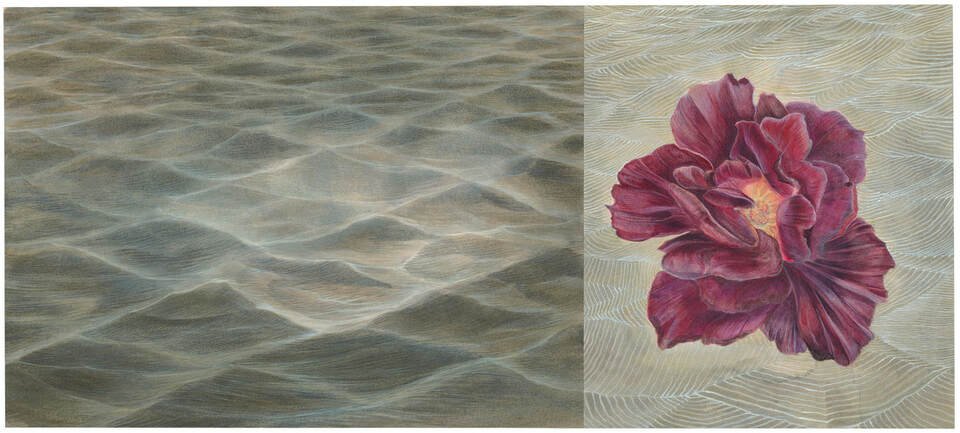
Daybreak, Christina Haglid, 2015-2018, watercolor and gouache on paper, 7.88h x 14.50w inches
Swaying with the ocean’s breath, illuminated orbs dance over translucent waves. Nighttime flowers blossom under moonlight. Peace washes over as glimmering stars brighten the endless midnight sky. Inspired by Christina Haglid’s ethereal artwork, Sarah Jacquelyn Interiors sets the space between light and dark.

What inspired us:
mysterious and spiritual quality
movement vs. calm nature of water
layers of ocean moving at night
juxtaposition of light and dark
floating quality of the orbs, glowing flowers
glowing effect of organic objects
story of the object and its environment
We used color and a 3D fabric texture to evoke the feeling of the ocean at night. Generous florals adorn a feminine bust with a mysterious gaze. Droplets of gold accents float over the blue tablecloth, emulating the ocean. Glowing orbs dance over waves of fabric on each end of the table setting.
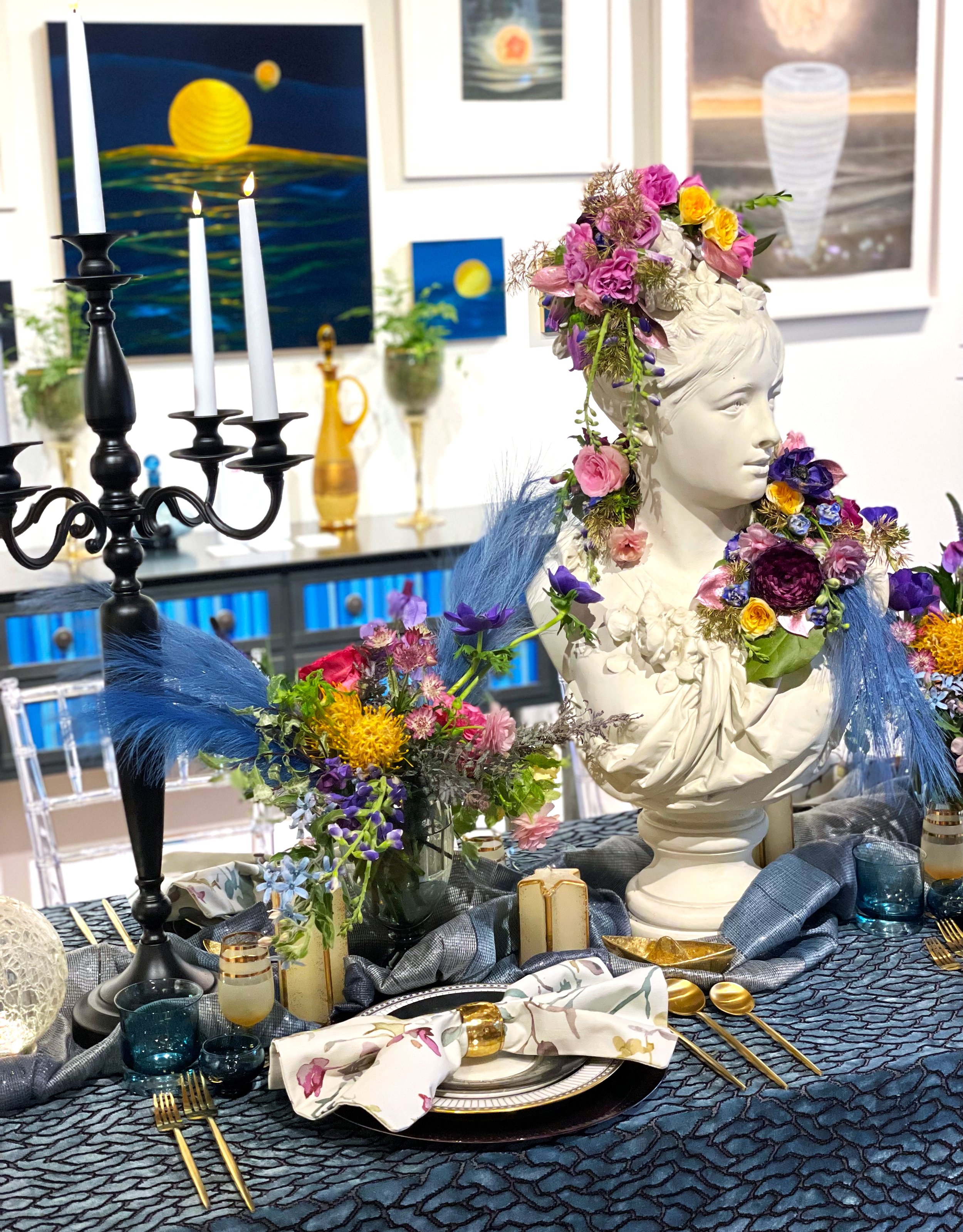

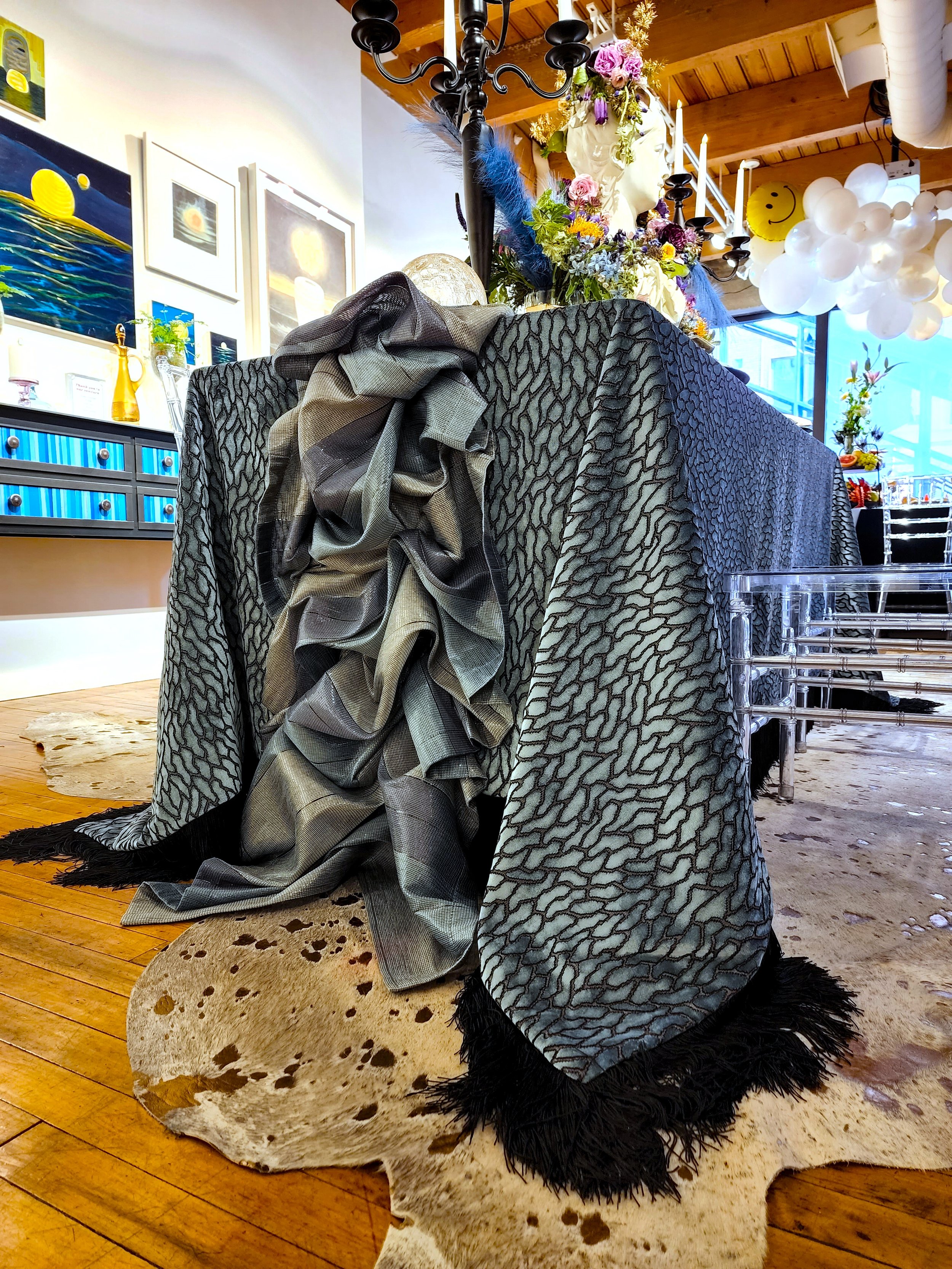
Thank you to everyone who came out to support us and a special thank you to all that made this tablescape possible. We couldn’t have done this without you!

The team, Sarah Jacquelyn Interiors

Need help designing the perfect table setting? Schedule a design consultation with our team today!

How to Design Your Living Room
Expert advice on how to design your living room.
1. First things first…paint last! It may seem counterintuitive, but with so many nuanced options, you'll want to get it just right. We used Benjamin Moore’s luscious ‘Galapagos Green’ in an ultra flat finish for the ceiling in our latest living room makeover. Be patient, and be bold!


Botanical Garden Living Room, Photo Credit Dustin Halleck

Best Specialty Art and Framing Project: ASID IL Design Excellence 2021, Photo Credit Dustin Halleck
2. Find your focal point. Every room has a natural center point, whether it's the fireplace, TV, or picture window with an expansive view. Plan furniture around this center line. Sometimes a room can have two focal points, like a TV wall and a fireplace. This is trickier, but with the right sectional, anything is possible. Art is one of my favorite focal points. A good frame makes the piece. Artists Frame Service is our favorite local framer. Art helps set the mood in the space, balances the weight of the room, adds color + texture, and creates a conversation starter.
Pro Tip: I love vacation art. These are special pieces picked up on your travels that bring you back to that time and place. Also, buy art done by family members, local artist’s pieces that speak to you, or try framing your own artwork!

Botanical Garden Living Room, Photo Credit Dustin Halleck
3. Select functional furniture. Opt for tight over loose cushions. You'll save yourself the trouble of constantly cleaning between the seats. Multifunctional furniture is great! Pull up ottomans on casters and add instant seating. Bonus if they cant be tucked away under a coffee table or console. Make sure there’s ample surfaces to live and function. Consider a console behind your sofa, end tables for a wine glass, or a coffee table 18-20" from the sofa edge.
4. Think about function & address traffic flow. Do you host super bowl parties and need seating for 8-10? Maybe the kids need it to be cozy, while you need it to be easy to clean. Perhaps it's just you, your partner, and your dog relaxing after a long day of work. Knowing how you will use the space will determine the direction of the design.
To find a flow, think about how you and your guests are entering and exiting this room. Are two points of entry needed? Does that point of entry cross the path of the TV? Can that be avoided?


Our Team: Violeta, Bianka, and Sarah (from Left to right)
5. Layer your lighting. Think ceiling lights, table lamps, floor lamps, and windows. Balance the light in the space. Make sure your lighting is on dimmers to adjust it has a day turns to night.
6. Bring in color. Start with the rug. Use the colors of the rug to influence the palette for the rest of the room. Your rug should be large enough that the front two feet of the sofa sit on it comfortably.
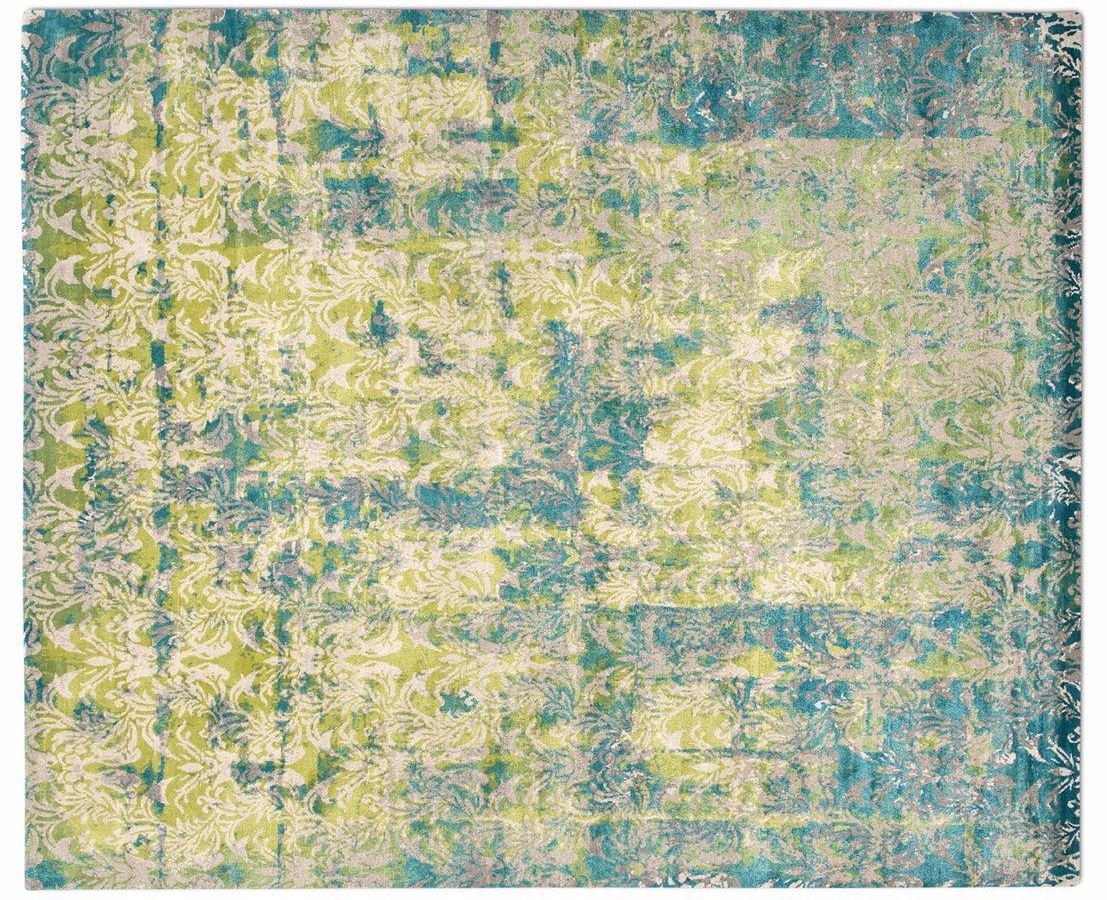
“Cover” by Knots Rugs, Sold Exclusively at Integral THread
7. Choose fabrics for your lifestyle. Busy living calls for stain treated or bleach cleanable fabrics depending on your needs (and how rowdy your guests get!) Cozy up with the final layer of pillows. Add in pattern, texture, and trim here. Have fun with it! These can be changed out seasonally or as you want to update your decor!

First Place winner of The Gallery Walk 2021, PHoto Credit Michael Kaskel.