
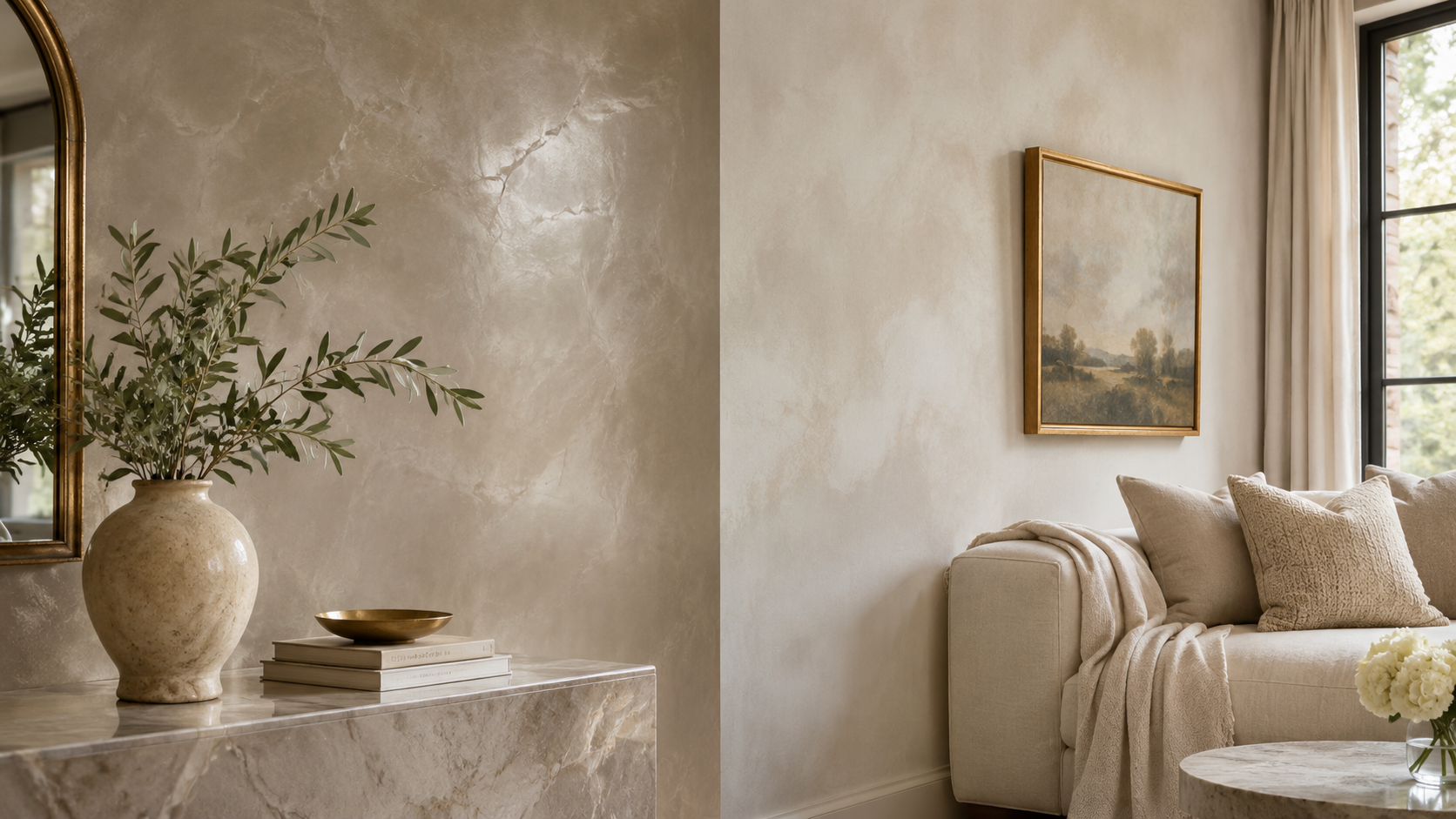
Venetian plaster is a troweled, burnished lime finish with a polished, stone-like depth, while limewash is a brushed, breathable mineral paint with a soft, matte, cloudy look. Venetian plaster costs more and stands up better in powder rooms and high-traffic spaces; limewash is more affordable and suits living rooms, bedrooms and brick. Our experienced Chicago team specifies both through interior decorating in Chicago and powder room design. Book a free design discovery call.
What Is the Difference Between Venetian Plaster and Limewash?
Both finishes start with lime, which is why they look so natural on Chicago walls. The difference is how they are made, applied and finished.
Limewash
Lime putty, water and mineral pigments, thinned to the consistency of watered-down paint
Brushed on in two or three coats with block brushes
Dries to a matte, chalky, cloud-like texture with visible movement
Breathable and naturally mold-resistant thanks to its high pH
Venetian plaster
Lime putty blended with marble dust, applied as a thicker plaster
Built up in multiple thin layers with a steel trowel
Burnished to a soft sheen or a high polish with real stone-like depth
Can be sealed with wax for added water resistance
Roman clay sits between the two. It is troweled like plaster but dries to a matte, suede-like finish that is easier to apply than true Venetian plaster.
Venetian Plaster vs. Limewash: Side-by-Side
Look: Limewash is soft and matte; Venetian plaster is smooth with a subtle to high sheen.
Cost: Limewash costs less in materials and labor; Venetian plaster needs a skilled applicator and more coats.
Durability: Burnished, sealed Venetian plaster resists scuffs better; limewash can chalk when rubbed and is refreshed with a new coat.
Moisture: Sealed Venetian plaster handles powder rooms and bathrooms well; limewash is best kept away from direct splashes.
Surfaces: Limewash suits brick, stone, stucco and unsealed plaster, and painted drywall needs a mineral primer first.
Touch-ups: Limewash blends easily; Venetian plaster repairs need an experienced hand.
Which Wall Finish Is Best for Each Room?
Powder rooms: Venetian plaster, often paired with statement lighting and a sculptural vanity
Living and dining rooms: Limewash or Roman clay for quiet texture behind art
Bedrooms: Limewash for a calm, matte backdrop
Kitchens and bars: Sealed Venetian plaster on range hoods and accent walls
Exposed brick: Limewash, which soaks into masonry instead of sitting on top
For full bathrooms and showers, a specialist lime finish such as tadelakt or a waterproof system is the safer choice. Our kitchen and bathroom design team specifies the right material for wet zones.
Plaster Wall Finishes in Chicago, IL
Chicago homes give these finishes a lot to work with. Renovating a Chicago greystone often means original plaster walls that take limewash beautifully, while vintage Gold Coast interiors and new high-rise condos in the West Loop suit the polish of Venetian plaster. As an experienced Interior Designer in Chicago, IL, we also specify finishes for clients in Lincoln Park, Evanston and Oak Park.
How Our Chicago Interior Designers Choose a Wall Finish
Review the room, lighting, wall condition and how the space is used
Compare limewash, Roman clay and Venetian plaster samples in your light
Coordinate color with furnishings, art and textiles
Coordinate a trusted specialty finisher and schedule the work
Style the finished room
Need a single expert opinion? Designer on Call covers finish selection in one visit. For a whole-home update, full service interior design handles every surface, and Finishing Touches completes the styling. See the results in our interior design portfolio.
Venetian Plaster vs. Limewash FAQs
Is Venetian plaster more expensive than limewash?
Yes. Venetian plaster typically costs more because it needs a skilled applicator, more coats and burnishing time. Limewash uses less material and is brushed on, so labor is lower. Final cost depends on wall size, wall condition, ceiling height and the finish level you choose.
How long does it take to apply Venetian plaster?
Venetian plaster takes longer than paint or limewash because it goes on in several thin coats, and each coat must dry before the next is troweled and burnished. A single room usually takes several days, while limewash can often be finished in a day or two.
Can I apply limewash myself?
Limewash is one of the more forgiving decorative finishes for a confident DIYer, since brush marks are part of its character. Venetian plaster is different: troweling and burnishing take practice, so most homeowners hire an experienced specialty finisher for an even result.
Which is more durable, Venetian plaster or limewash?
Venetian plaster is more durable on high-traffic walls, especially when burnished and sealed with wax. Limewash is softer and can chalk when rubbed, but it ages gracefully, and worn areas are refreshed with another coat instead of a full redo.
Can you use limewash or Venetian plaster in a bathroom?
Sealed Venetian plaster works well in powder rooms and on bathroom walls away from direct water. Limewash is breathable and mold-resistant but should stay out of splash zones. For showers and tub surrounds, choose tadelakt, tile or another waterproof system specified for wet areas.
Is Roman clay the same as limewash?
No. Roman clay is a troweled lime-based plaster with a matte, suede-like finish. Limewash is brushed on like paint and has a softer, cloudier texture. Roman clay is often chosen when you want more depth than limewash without the polish of Venetian plaster.
Can you limewash over painted drywall?
Yes, with preparation. Limewash bonds best to porous surfaces such as brick, stone and unsealed plaster. Painted or sealed drywall needs a compatible mineral primer first so the limewash can grip and develop its natural texture.
How long does limewash last indoors?
Interior limewash commonly lasts 10 to 15 years with gentle care. Clean it by dusting and spot-cleaning with a barely damp sponge. A matte sealer can be added in hallways and family rooms that see more contact.
Does Venetian plaster crack?
Venetian plaster is applied in thin layers and is flexible enough for normal interior use, but hairline cracks can appear if the wall behind it moves. Proper wall preparation and an experienced plaster applicator are the best protection.
Which wall finish is best for a Chicago home?
It depends on the room. Limewash suits brick, bedrooms and living spaces in greystones and bungalows. Venetian plaster suits powder rooms, dining rooms and polished condos. An expert interior designer can test samples in your light before you commit.
Can an interior designer help choose and install plaster wall finishes?
Yes. A Chicago interior designer selects the finish and color, coordinates it with furnishings and lighting, and schedules a trusted specialty finisher. Sarah Jacquelyn Interiors, led by Sarah Schwuchow, ASID, NCIDQ, includes finish selection in its design services.
How do I get started with a plaster finish in Chicago?
Start with a free design discovery call. We will talk through the rooms, your style and timeline, then recommend Designer on Call for a single decision or full service design for a larger project. Schedule your free design discovery call.